Wednesday, March 19, 2014

"Type 2 Breakthrough?"

The article: “Major Step in Preventing Type 2 Diabetes” written by Haley Bridger, Broad Institute Communications, on March 2, 2014 talks about a huge breakthrough in preventing type 2 diabetes.  Researchers at the Broad Institute and Massachusetts General Hospital basically found mutations in a gene that is believed to reduce the risk of type 2 diabetes in people including people with risk factors such as obesity and old age.


          (http://www.webmd.com/diabetes/ss/slideshow-type-2-diabetes-overview):

They basically discovered that rare mutations of the gene “SLC30A8” can reduce the risk of type 2 diabetes by 65%. This drug was tested on people of different ethnic groups, and the drug worked, proving that it may work on people world-wide.

What makes the mutation of this gene so important in fighting type 2 diabetes? Well, the protein that is encoded by “SLC30A8” is shown to play an important role in insulin-secreting in the pancreas, and also somewhat influence the risk of type 2 diabetes. If this protein is activated, it may just be the best possible way to reduce risk. The research group found that the mutation terminates the function of the gene “SLC30A8”. This mutation affects the function of the protein ZnT8 which transports zinc into insulin producing beta cells. Zinc is very important in the steps of creating insulin. Researchers, currently, are looking into why this can reduce the risk of type 2 diabetes.

This is a huge breakthrough and, in my opinion, a very important one. Type 2 diabetes effects the lives of more than 300 million people world-wide. While you can change your lifestyle habits by what you eat, exercising and taking medicine, there is no real cure. I think that it’s great that they are conducting research on something that can really reduce your chances of getting type 2 diabetes. If type 2 diabetes isn't managed correctly, it can be fatal. It’s so common that I almost truly believe that we should really thrive to find a definite cure for it.

I chose type 2 diabetes for my blog because it has a lot to do with what we were recently learning about in class. We basically learned that you have insulin receptors on your cells which receive insulin. This then allows the receptors to send a signal to GluT transporters, telling them to open. With type 2, this whole communication system is fried so when the receptors receive insulin, they don’t send signals and the GluT transporters remain closed. We didn't spend a lot of time on type 2 diabetes so I was still curious on why it’s so hard to find a common cure, and I also wanted to learn more about it. This article was very interesting to me because there at a breakthrough in finding a cure for type 2. I’m curious to see what will come of this breakthrough in the future. Will it be confirmed as a solution for greatly lowering your risk of type 2 or not?

Post by Connor Mulligan

Tuesday, March 18, 2014

Change Your Microbes and Change Your Weight


The article “Bacteria in the Intestines May Help Tip the Bathroom Scale, Studies Show” written by Denise Grady on March 27, 2013 from the New York Times, talks about new research that has revealed that bacteria in your gut helps to determine whether you gain or lose weight.

Gastric bypass surgery is a very common weight loss surgery, however scientists have not fully understood why this surgery works until now. New studies show that this surgery works mainly because the microbe levels, or bacteria in your intestines, are altered when you have this surgery.

Gastric bypass surgery is a surgery to make your stomach smaller. Your stomach is divided into a small upper section and a larger bottom section. The top section of your stomach is where your food will now go, and it holds only about 1 ounce of food. A small part of your jejunum is then connected to a small hole in your new, smaller stomach. The food you eat will now travel from the stomach into this new opening into your small intestine. The duodenum and a small part of the jejunum are now bypassed, or skipped, so there is less absorption of calories.
 

However, besides less absorption of calories, another major reason why this bypass surgery works is the change in microbe levels, or microbiota, which account for a reasonable percentage of a person’s weight loss after this surgery. Usually after this surgery, patients lose about 65% to 75% of their excess weight, and 20% of that weight loss has been found is due to the microbiota in your intestines.

Researchers at Massachusetts General Hospital including Dr. Lee M. Kaplan, director of the obesity, metabolism and nutrition institute, say that this new information could gradually lead to treatment that could alter the microbiota in the intestines to help people lose weight without having the bypass surgery. But for now, the gastric bypass surgery is the most effective weight loss procedure.  Dr. Kaplan says, “In no way is manipulating the microbiota going to mimic all the myriad effects of gastric bypass. But if this could produce 20 percent of the effects of surgery, it will still be valuable.” He means that the bypass surgery has other beneficial results that don’t have to do with the microbiota so the surgery is still the best way to lose weight, however if they could come up with a treatment to lose 20% of the effects, it would still be worth it.

The exact way that the intestinal microbiota can cause weight loss is still being researched. Scientists do know that people who tend to gain more weight have certain microbes to make them gain weight that trim people might not have.

A study in which scientists took the breath tests of 792 patients to figure out what microbes they had in their intestines, revealed that the microbe Methanobrevibacter smithii is present in these people who tend to gain weight. It is most likely partially responsible for their obesity because this microbe is designed to absorb as many calories as possible from food. Thousands of years ago, humans might have needed this microbe when they needed every calorie they could get out of their food because they didn’t know when their next meal would be, but with a modern day diet, these microbes are not needed. It is believed that other microbes might be similar to this microbe and might be somewhat responsible for a person’s obesity, so by changing or removing these microbes, it could help a person lose weight.

This article relates to our biology class because we have talked about bypass surgeries. When we were on our Circulatory System unit, we talked about coronary bypass surgery. This surgery occurs when a coronary artery is clogged, and oxygen-rich blood can’t get to your heart’s muscles to keep it pumping. So, you need to have a bypass surgery which takes a vein from your leg to go around, or skip, the blocked coronary artery. The gastric bypass surgery is just like this surgery, but instead, it is going around, or skipping, the duodenum.

It also relates to our class because we have talked about the bacteria that is in our intestines when we read “The Bacteria inside My Gut” by George Liles during the digestive system unit. We read about how once your food reached your intestines, there are more than 5,000 species of microbes that live there. They contain enzymes that are needed to break down foods that our bodies can’t digest. They then convert the nutrients to energy, and create gaseous waste as a byproduct of this process.

I think these new findings could be very beneficial because scientists might be able to find a treatment to help a person lose weight without having to have a surgery. A medicine that could change the microbe levels in your body would help you avoid the money, effort, pain, and recovery time of a bypass surgery. This new information could be a crucial step in understanding weight gain and weight loss.


Ancient Amoeba-Killing Virus Resurrected

Recently, I came across a very interesting article on the New York Times website; “Out of Siberian Ice, a Virus Revived,” by Carl Zimmer (http://www.nytimes.com/2014/03/04/science/out-of-siberian-ice-a-virus-revived.html?ref=science&_r=0).


This article is about the revival of a virus that has been frozen in the permafrost of a Siberian riverbank for over 30,000 years. Discovered by a team of researchers led by Chantal Abergel and Jean-Michel Claverie from Aix-Marseille University in France, this virus is completely new to the world of science. Scott O. Rogers of Bowling Green State University believes that being able to retrieve a virus that is so old, and being able to actually grow it “goes beyond what anyone else has done.” Nothing like this has been possible before, and is an amazing feat for these scientists.

The researchers found that when they added pits of the permafrost to amoebae, they amoebae began to die. They discovered that giant viruses were multiplying inside the amoebae and killing them. 

During their research and experiments, they found that the virus is much different from the common ones we know today. This new virus, that they called pithovirus, is 1.5 micrometers long and 25 percent bigger that viruses found before.  According to Dr. Arbergel, “Sixty percent of its gene content doesn’t resemble anything on earth.” They believe that these viruses must have been parasitic life forms that were common very early in the history of life.

Although these viruses are different from anything any scientists have seen before, they pose no threat to humans. This particular virus only infects amoebae, but some scientists are concerned that some other disease-causing viruses could still be undiscovered in the permafrost. They believe that even though it is possible that some viruses could infect humans, the risk of an outbreak is extremely low.

This year in biology class we have been learning about cells, bacteria, and viruses. We have learned that, in humans, viruses infect the host cell and use it to infect the rest of the body. When the viruses are infecting single-celled organisms, like amoebae, they don’t have anything else to attack, and they end up just killing the organism.

I think it’s amazing that the scientists were able to grow a virus back to its normal activity after 30,000 years of being frozen in permafrost. I never thought that anything like that could be possible. Who knows, maybe next they’ll be able to bring animals back from extinction!  

Picture Citation:
Bartoli, Julia. Pithovirus. 2012. Science, France. The New York Times. Web. 8 Mar. 2014.

Friday, March 14, 2014

The Fight Against HIV

I read  an article titled"Gel Protects Monkeys From HIV After Sex" It was written by Donald G. McNeil Jr. on March 12, 2014 on http://www.nytimes.com/2014/03/13/health/gel-protects-monkeys-from-hiv-after-sex-study-finds.html?ref=science

In this article they talk about possible protection from HIV in a gel applied after sex with an infected mate. The gel would only be used in females however. This gel doesn't have a complete 100% success rate though with one of six macaques given it still contracting HIV. The gel contains raltegravir  which prevents the virus from integrating with the cells DNA.

HIV is a virus caused by the virus connecting with the CCR-5 protein receptor on your cells. It connects to these receptors causing the cell to open allowing it to enter the cell and infect it. Once it gets in it bursts open the cell causing it to go to other cells in the body.

Macaque monkey
However the human testing on this gel does cause moral conflict. Because the gel is combating what could be a deadly disease they can't really justify giving someone a placebo. The other possible option is instead of a placebo they give the person another drug already approved for human use.

This connects to our biology class because we were talking about cell receptors and mutations allowing people to be immune to HIV. This immunity comes from not having the CCR-5 receptor. Without this receptor the cell will not open so the virus can not get in.
"Macaque" http://www.theguardian.com/science/2008/oct/16/neuroscience-medicalresearch

Thursday, March 13, 2014

Stay Between the Lines- Type 1 Diabetes

The article by Riva Greenburg, "Type 1 Diabetes Finally Explained" explains everything you need to know about Type 1 diabetes and how its different from Type 2 diabetes.
 
 Type 1 diabetes is an autoimmune condition. Your body destroys you pancreas' insulin-producing cells. You no longer produce insulin, or may just produce a very small amount. No one knows what actually causes type 1 diabetes yet, but that doesn't mean they never will. Its most likely genetics or a virus. The only treatment right now is to replace the insulin that your body no longer makes.
 
Type 1 diabetes is very different than type 2 diabetes. Most people know much more about type 2 diabetes than they do about type 1 because of all the commercials that they have. One cause of type 2 diabetes is that your body doesn't produce enough insulin to be used, the second cause is your body doesn't use the insulin you make correctly.
 
In type 1 diabetes you have to monitor your blood sugar and based on the numbers you give yourself insulin either with a pump or by giving yourself a injection. Diabetics need to keep their blood sugar levels below 180 mg/dl (9.9 mmol/1) and  above 55 mg/dl (3 mmol/1).
 
 
If your blood sugar level drops below 55 mg you will experience hypoglycemia, which causes confusion, or you may become irritable. If you sugar level drops below 40 mg you will experience severe hypoglycemia. You may become unconscious and you may need to call 911. If the paramedic doesn't come in time and give you glucose you can die. If you go above 180 mg you have too much sugar in your blood which causes damage to your small and large blood vessels. High blood sugar damages everything in your body, eyes, heart, kidneys, feet... everything.
 
 My cousin was diagnosed with type 1 diabetes when she was 13, and she experienced severe hypoglycemia. It was a very scary situation because the doctors didn't diagnose her right away and she almost went into a coma. She now has a pump and must test her blood sugar regularly and makes sure she stays between the lines.
 
Even though this blog has to do more with type 1 diabetes,  we have been learning about type 2 diabetes in class and how it has to do with the receptors defecting in its signaling. Receptors receive chemical messages, they bind to molecules on the outside, change shape and send a message to the inside of the cell. Type 2 diabetes is non-insulin dependent unlike type 1 diabetes. The insulin receptors get signals from insulin but the message never gets to one type of gluT channel to instruct it to open.
 
Diabetes type 1 and 2 is a difficult disease to live with and must be controlled everyday.


Sources:


Wednesday, March 12, 2014

Gluten is Everywhere!

This post centers around an article published by The New York Times called “Who Has the Guts for Gluten?” by Moises Velazquez-Manoff. Published on February 23, 2013

If you were to go out today, select any random person, and ask them if they have ever heard the terms “gluten” or “celiac disease,” chances are they will have heard the terms used quite frequently. It seems that gluten is everywhere these days. There’s gluten-free this and gluten-free that, but if you were to ask that same person if they know the scientific definition of gluten or what celiac disease can do to one’s body, you will probably receive a puzzled, blank stare.

In an article published by The New York Times, titled “Who Has the Guts for Gluten?,” author Moises Velasquez-Manoff explains what gluten is, the effects gluten can have on those with celiac, the discussed causes of celiac disease, and why the disease is affecting so many people in the US. Manoff explains that celiac disease is considered an autoimmune disorder, or a condition that occurs when the immune system mistakenly attacks and destroys healthy body tissue. The effects of this disease range from diarrhea and anemia, to osteoporosis, and in severe cases, lymphoma.

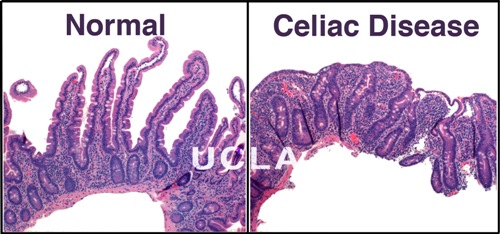
Manoff explains that “Nearly everyone with celiac disease has one of two versions of a cellular receptor called the human leukocyte antigen, or H.L.A. These receptors, the thinking goes, naturally increase carriers’ immune response to gluten.” thus making them unable to tolerate the protein that is found in wheat, rye, and barley called gluten. If ingested, the immune system reacts by damaging or destroying the villi of the small intestine. Villi allow nutrients from food to be absorbed into the bloodstream, so if that villi is destroyed the person will become malnourished no matter how much he/she eats.This particular article investigates why the prevalence of celiac disease has quadrupled in just 50 years.Celiac2.jpg
I found this article very interesting because, like most people, I really did not know anything about gluten or celiac disease. While reading I was able to make many connections to both what i have learned in school and my life outside of the biology classroom. For example, my boyfriend’s father, grandfather, and sister all have celiac disease. The article mentioned that roughly 30% of people with European ancestry carry the genes responsible for celiac and my boyfriends father is of Swedish descent, and his grandfather is 100% Italian.

I also connected this article to what we’ve been learning about in biology. We recently learned about cell receptors and we found out what their function is. Cellular receptors receive chemical messages and send those messages to the inside of the cell. The quote stated above talks about the receptor called human leukocyte antigen. The more of these receptors the body has, the more sensitive it will be to gluten.

I thought the article was interesting, but I did think it dragged on a lot. I felt as if there was almost too much information that it got overwhelming at times. For example, it got quite hard to continue when it began talking about the study comparing Russia and Finland. I did, however, find it fascinating to read all the different theories as to what causes or can help prevent the disease. For example, it was mentioned that breast feeding may help prevent the disease and how the abundance of gluten in processed food may be a leading cause of the disease. As of right now, there is no cure for celiac disease but scientists are still searching.


Pictography:

http://gastro.ucla.edu/body.cfm?id=20

Tuesday, March 11, 2014

Destroying the Ozone, one gas at a time

Recently, I read the article “Four new harmful gases threaten Earth’s ozone: Study” by Rick Docksai that was posted on March 11th, 2014 on Science Recorder.
                In the article it was stated that four new gases were found that were contributing to the depletion of the ozone. These new gases are, of course, caused by humans and they are being considered as greenhouse gases. A couple of these newly found gases are gathering at rates that are causing researchers to show concern.

                Johannes Laube had said in the article that, “Their increasing concentrations thus hold implications for global warming, as well.” According to Laube and a bunch of his colleagues, these four gases are contributing to Global Warming and the main culprit, CFC-113a, is coming from agricultural insecticides. It seems outrageous to me that farmers are still using fertilizers when it looks like they are causing more harm than help. However, the source was just an educated guess and the actual source of CFC-113a is still unknown to researchers.  

                Scientists had figured out that these gases were affecting the atmosphere by looking at air samples taken from the 1970’s to now and in their findings they saw that these four new gases were only popping up only recently. This led the scientists to believe that it was the result of humans and our more modern and recent activities involving greenhouse gases.  

                There was an agreement known as the Montreal Protocol which banned 13 of the CFC’s causing ozone depletion and in 2010 there was another agreement that added to the protocol that banned all CFC’s. I believe a new extension should be brought in this year or in some of the coming years banning these four new gases because it seems we are still destroying the ozone and therefor killing ourselves. However, this was caught in the early stages and it can be helped now. Like the other CFC’s, these four new gases take decades to break down so they will affect the atmosphere for long periods of time.

                I remember in biology class we were studying biogeochemical cycles and the topic of human contributions to these cycles had come up. Humans contributed to all of the cycles and some of the consequences were disastrous such as more extreme weather events and global climate change. So these new greenhouse gases are having basically the same consequence so I would strongly recommend cutting down on these greenhouse gas emissions.

                I have done other projects and a blog post that included the effects of global warming and greenhouse gases on the ozone layer and they aren’t very good. These gases are just circulating in the air and trapping heat causing warmer climates and glaciers to melt. I have read some posts on how global warming is affecting polar bears and other arctic animals by destroying their habitats. It’s unfair to animals because we are killing them and destroying their homes when they haven’t done anything to deserve it.

                I believe that researchers should continue their work and try to find all of the greenhouse gases that are invading our atmosphere. Then it is our job, as people, to help eliminate the sources of these contaminants and it is the job of our government and the rest of the governments around the world to crack down on factories and industries that are emitting greenhouse gases. Everyone just has to work together to fix what we had started.

http://www.esrl.noaa.gov/research/themes/o3/img/fig1.jpg

                                        http://www.esrl.noaa.gov/research/themes/o3/